 Spot Startups
TarotAI Review: A Simple Way to Explore Tarot Readings Online
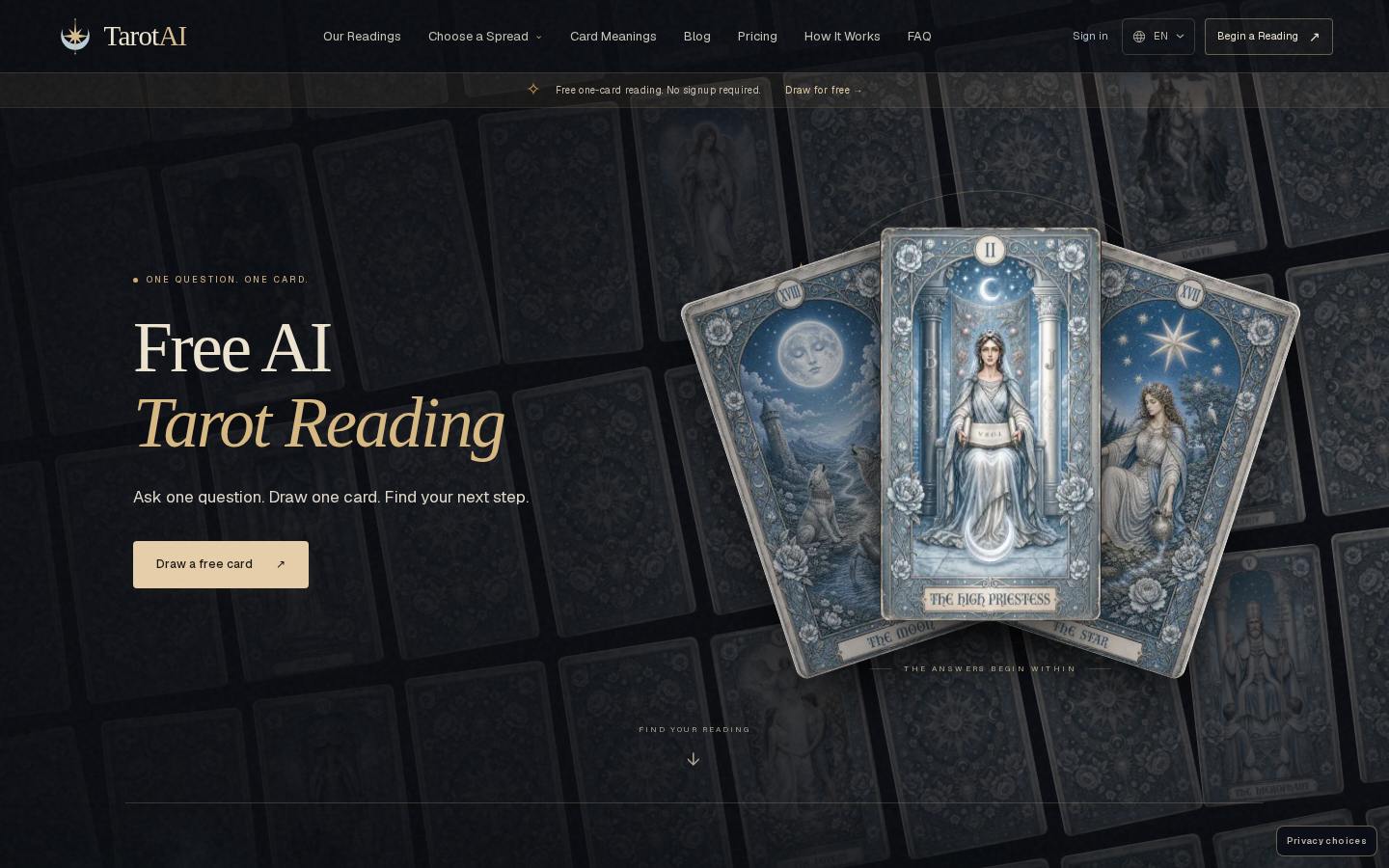
Sometimes, you have a question on your mind but aren't quite sure how to think about it. It might be about a relationship, a career decision, or a change you've been considering. Tarot has long offered people a way to reflect on these situations, and now AI is making that experience more accessible online.
TarotAI brings tarot card readings into a digital experience where users can ask questions, draw cards, and explore their meanings without needing to own a physical deck or learn every card in advance.
The website offers several reading formats, from a quick one-card draw to more detailed spreads for relationships, career choices, and other personal questions. It also provides a daily tarot reading and a library of card meanings for people who want to learn more about the practice.
In this review, we'll look at what TarotAI offers, how its readings work, its pricing options, and who might find it useful.
What Is TarotAI?
TarotAI is an online tarot reading platform that uses AI to interpret tarot cards in the context of a user's question. Rather than simply displaying a card and its general meaning, the experience is designed to connect the card's symbolism with the situation being explored.
For example, someone thinking about changing jobs might choose a career-focused spread, while a person reflecting on a relationship could select a reading designed around relationships and emotions.
The platform provides different spreads depending on how much detail someone wants to explore. Users can start with a single card for a quick reflection or choose layouts with multiple cards to examine different aspects of a situation.
One practical detail is that you can begin drawing cards without creating an account. The website offers a free one-card reading, making it possible to explore the experience before deciding whether to use the service regularly.
You can visit the platform at TarotAI.ai.
What Makes TarotAI Different From a Traditional Tarot Reading?
Traditional tarot readings often involve a reader interpreting cards during a session, or an individual learning the meanings and interpreting a spread themselves.
TarotAI takes a more guided, digital approach. It helps users choose a suitable spread, draw cards, and understand how the cards relate to the question they have in mind.
This can be particularly helpful for beginners who are interested in tarot but find the number of cards, symbols, and interpretations difficult to navigate.
Instead of starting with a book of card meanings, users can begin with a real question and explore the interpretation step by step.
The AI element makes the experience interactive, but it is important to understand what that means. AI-generated interpretations are not evidence of supernatural insight or reliable predictions about future events. Their value lies in helping users explore ideas, emotions, and possible perspectives.
Exploring the Main Features of TarotAI
Rather than focusing on a single type of reading, TarotAI offers several ways to approach a question.
1. One-Card and Yes-or-No Readings
Not every question needs a lengthy reading. Sometimes, users simply want a starting point for reflection.
TarotAI offers a one-card reading where users focus on a question and draw a card to explore its symbolism. Its yes-or-no format provides another way to approach a specific concern.
Although the format is straightforward, the result should be treated as an interpretation rather than a definitive answer. A card cannot establish whether a relationship will work out or whether a particular decision will succeed.
For someone new to tarot, however, a single-card reading is an approachable way to learn how the process works.
2. Relationship and Love Readings
Relationships are one of the most familiar reasons people turn to tarot. Questions about communication, compatibility, changing feelings, and difficult decisions can be emotionally complicated.
TarotAI includes dedicated relationship spreads alongside readings for love-related questions. These formats give users a structured way to reflect on relationship dynamics and their own expectations.
For example, someone uncertain about whether to continue pursuing a relationship could use a reading to consider what they want, what concerns them, and which choices are available.
The most useful approach is to focus on your own feelings and decisions rather than treating a reading as a way to discover another person's private thoughts.
3. Career and Decision-Making Spreads
TarotAI also caters to people facing professional or personal crossroads.
Its spread options include formats for general situations, comparing two choices, and examining more complicated circumstances through larger layouts.
Imagine you're deciding whether to stay in your current job or explore a new opportunity. A structured reading can give you a prompt to think about your priorities, concerns, and possible next steps.
It won't replace practical research, financial planning, or career advice. But some people may find the reflective exercise useful when they need to organize their thoughts before making a decision.
4. Daily, Weekly, and Monthly Guidance
For users who enjoy making tarot part of their routine, TarotAI offers readings associated with different time periods.
The website includes daily guidance, weekly readings, and monthly themes. These provide a way to revisit tarot regularly rather than using it only when a major question comes up.
A daily card, for example, can serve as a prompt to think about patience, communication, confidence, or another theme throughout the day.
The website also features a collective daily tarot reading. This is a shared interpretation for visitors, not an individualized reading based on each person's circumstances.
5. Different Spreads for Different Situations
One of TarotAI's useful design choices is its range of card layouts.
Depending on the question, users can explore formats such as:
General Reading: A three-card spread covering the situation, challenge, and direction.
Two Paths: A five-card layout for comparing two choices.
Relationship Reading: A spread focused on relationship dynamics.
Horseshoe: A seven-card layout examining context, influences, advice, and direction.
Celtic Cross: A ten-card spread for exploring a more complex situation.
These formats give users a choice between a quick reading and a more detailed exploration. They also help beginners understand that tarot spreads have different purposes rather than treating every reading as the same exercise.
6. Tarot Card Meanings for Learning
TarotAI isn't limited to generating readings. Its website also includes a card-meaning section where visitors can explore traditional tarot symbolism.
This is useful for people who want to understand the cards themselves instead of relying entirely on AI-generated interpretations.
Reading about individual cards alongside an actual spread can make it easier to understand how a card's meaning may change depending on its position and the question being explored.
For beginners, this learning component adds value beyond simply receiving a reading.
How to Get Started With TarotAI
Getting started is relatively simple, even if you have never used tarot cards before.
Step 1: Choose a question.
Think about what you want to explore. It could be a career decision, a relationship concern, or a general question about your current circumstances.
Step 2: Select a reading.
Choose a one-card reading for a quick reflection or select a larger spread if you want to examine different aspects of the situation.
Step 3: Draw your cards.
Follow the on-screen instructions to draw the cards for your selected spread.
Step 4: Read the interpretation.
Explore the card meanings and the interpretation in relation to your question. Take time to consider which parts are relevant to your circumstances.
Step 5: Decide what to take away.
Use the reading as a starting point for reflection. You can consider additional questions, but your decisions should ultimately be based on your own judgment and real-world information.
The process does not require prior tarot knowledge, which makes the website accessible to people who are simply curious about the practice.
How Much Does TarotAI Cost?
TarotAI offers a free entry point as well as paid subscriptions for users who want more readings.
According to the website's published pricing, the available plans are:
Free — $0: Includes 10 credits each day when signing in and one basic one-card reading per day, with no payment method required.
Basic — $7.99 per month: Includes 1,500 monthly credits, additional daily sign-in credits, and access to credit-based spreads.
Pro — $12.99 per month: Includes 5,000 monthly credits, a larger daily credit allowance, and access to credit-based spreads.
Annual Unlimited — $99.99 per year: Includes unlimited standard tarot readings across the currently available spreads, subject to fair-use terms.
The Basic and Pro plans list a three-day free trial. A payment card is required for these trials, and the subscription becomes paid unless cancelled before the trial ends.
Credit allowances and subscription terms can change, so check the official TarotAI pricing page before subscribing.
For occasional use, the free option is a sensible place to start. Users who regularly explore longer spreads may want to compare the credit allowances and subscription costs before upgrading.
Who Might Find TarotAI Useful?
TarotAI is likely to appeal to several types of users.
People new to tarot: The guided reading process makes it easier to explore card meanings without studying an entire deck first.
Regular tarot enthusiasts: Multiple spread formats provide options for different questions and levels of detail.
People who enjoy journaling and reflection: A reading can provide a theme or prompt for thinking about personal goals, relationships, and decisions.
Users looking for a convenient online experience: The ability to draw cards through a website makes tarot accessible without purchasing a deck or arranging an in-person session.
People interested in tarot symbolism: The card-meaning guides provide an additional way to explore the practice and learn how different cards are interpreted.
It may be less suitable for anyone expecting guaranteed predictions, factual answers about another person's feelings, or professional guidance for serious financial, medical, or legal decisions.
What to Keep in Mind Before Using TarotAI
The convenience of AI tarot readings is appealing, but a few considerations are worth mentioning.
First, AI-generated readings can sound personal and convincing without necessarily being accurate. Their interpretations should not be confused with verified facts about your life or future.
Second, tarot is best approached as a reflective or entertainment activity rather than a substitute for evidence-based decision-making. If you're considering a major career move, for example, practical considerations such as income, opportunities, and long-term goals remain important.
Finally, check the subscription details before starting a paid trial. Understanding how credits work, when billing begins, and how cancellation works will help you choose the option that suits your usage.
These points do not take away from the platform's purpose. They simply establish realistic expectations for using AI as part of a tarot experience.
Is TarotAI Worth Trying?
TarotAI offers an approachable way to explore tarot online without requiring users to understand every card or spread before getting started.
Its range of reading formats is one of its strengths. A person looking for a quick daily reflection can use a one-card reading, while someone exploring a more complicated question can choose a larger spread. The card-meaning guides also make the platform useful for people who want to learn more about tarot.
The free entry point is another advantage, allowing curious users to try a basic reading before committing to a subscription.
The main limitation is one shared by AI-generated interpretations generally: a thoughtful-sounding answer is not necessarily a prediction or a reliable account of reality. Users will get the most out of TarotAI when they approach the readings with curiosity rather than treating them as instructions for important life decisions.
Our take: If you're curious about tarot and want a convenient way to explore its symbolism, TarotAI is worth a look. Its combination of guided readings, different spreads, and card-meaning resources makes it a useful starting point for casual users and tarot enthusiasts alike.
Visit TarotAI.ai to try a reading.
Frequently Asked Questions About TarotAI
Is TarotAI free to use?
Yes. TarotAI offers a free option that includes a basic one-card reading each day, along with daily credits for signed-in users. Paid subscriptions are available for people who want greater access.
Do I need to create an account?
No account is required to choose a spread or draw cards. The website says signing in is needed for certain features, such as continuing into an AI conversation or saving a reading.
Can beginners use TarotAI?
Yes. Users can begin with a simple one-card reading and explore more detailed spreads as they become familiar with tarot.
What kinds of questions can I ask?
You can explore questions about relationships, work, personal choices, creativity, and other areas of life. Questions focused on your own decisions and feelings can be particularly useful for reflection.
Can TarotAI predict the future accurately?
TarotAI should not be treated as a reliable way to predict future events. Its readings provide interpretations of tarot symbolism that may help users reflect on their circumstances, but they cannot guarantee an outcome.
Is a paid TarotAI subscription necessary?
Not necessarily. The free option may be sufficient for occasional readings. A paid plan may make sense for users who want to explore longer spreads more frequently.
Where can I try TarotAI?
You can access the platform directly at https://tarotai.ai/, where you can explore the available spreads, draw cards, and read about their meanings.