 Spot Startups
How to Audit Your Startup Website for AI Search Visibility: A Practical GEO Checklist
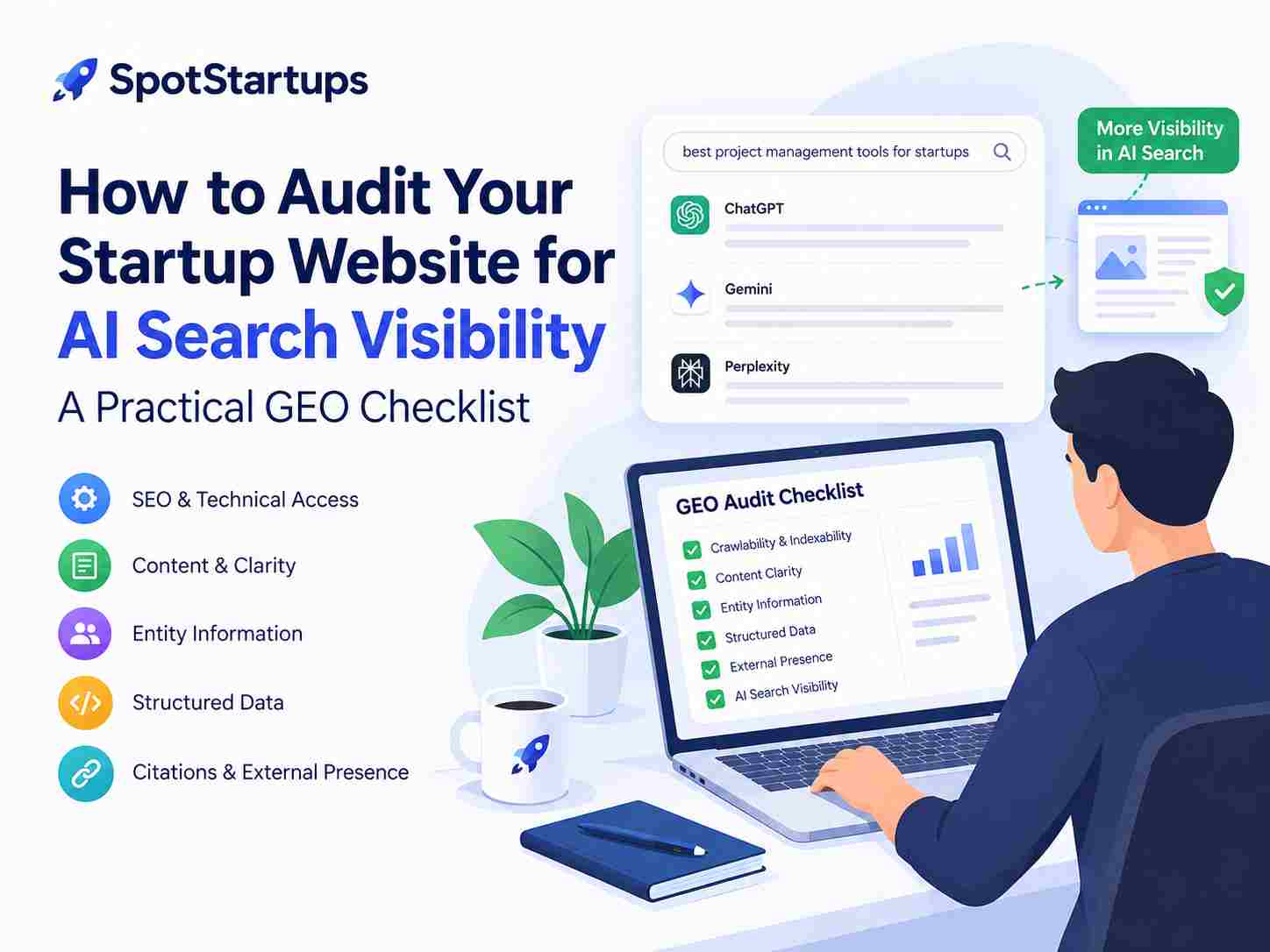
Search is changing. People are increasingly asking AI systems such as ChatGPT, Gemini, Perplexity, and Google's AI-powered search experiences to find products, compare companies, answer questions, and recommend tools.
For startups, this creates a new visibility problem: your website can rank in traditional search and still be difficult for AI systems to understand, discover, or mention.
That is where a GEO audit comes in.
A good Generative Engine Optimization (GEO) audit looks beyond traditional rankings. It examines whether your startup website is technically accessible, easy for AI systems to understand, supported by trustworthy information, and useful enough to become a source in AI-generated answers.
This guide explains how to audit your startup website for AI search visibility and gives you a practical GEO checklist for startups that you can use without expensive software.
What Is a GEO Audit?
A GEO audit is a systematic review of a website to determine how well its content can be discovered, understood, retrieved, and potentially cited or mentioned by generative AI search systems.
Traditional SEO asks questions such as:
- Can Google crawl this page?
- What keywords does it target?
- Where does it rank?
- Does it receive organic traffic?
A GEO audit adds another layer:
- Can AI systems understand what this company does?
- Can they identify the company's products or services?
- Are important facts easy to extract?
- Is there enough evidence to support the company's claims?
- Do independent websites mention the company?
- Does the website provide useful information beyond generic marketing copy?
- Does the startup appear when users ask relevant questions to AI search systems?
The goal is not to “hack” an AI system. The goal is to make your website easier for both people and machines to understand.
1. Start With an AI Visibility Test
Before changing anything, find out how your startup currently appears in AI search.
This is one of the most important steps in an AI search visibility audit because you need a baseline before you start making improvements.
Search for your startup using several different types of questions.
Test 1: Branded Questions
Try queries such as:
- “What is [Startup Name]?”
- “What does [Startup Name] do?”
- “Who founded [Startup Name]?”
- “What products does [Startup Name] offer?”
- “Is [Startup Name] a SaaS company?”
Test 2: Category Questions
Now remove your brand name.
For example, if your startup provides project management software:
- “Best project management tools for startups”
- “Project management software for small teams”
- “Alternatives to [major competitor]”
- “Affordable project management tools”
Test 3: Problem-Based Questions
These are particularly valuable.
Instead of asking about your product, ask about the problem your product solves:
“How can a small startup manage remote projects?”
“What tools can startups use to manage distributed teams?”
“What is the easiest project management software for a five-person startup?”
Record what happens.
- Does the AI mention your startup?
- Does it cite your website?
- Does it understand your product correctly?
- Does it confuse your company with another business?
- Does it mention competitors but not your startup?
Create a simple spreadsheet with columns such as:
| Query | AI Platform | Startup Mentioned? | Website Cited? | Competitors Mentioned | Accuracy |
|---|---|---|---|---|---|
| What is [Startup]? | ChatGPT | Yes/No | Yes/No | — | Good/Needs Fix |
| Best tools for X | Gemini | Yes/No | Yes/No | Competitors | Good/Needs Fix |
| How to solve X | Perplexity | Yes/No | Yes/No | Competitors | Good/Needs Fix |
Do not treat one AI response as a permanent ranking. AI answers can change between queries and platforms. Your goal is to identify patterns in AI visibility, not create a single score from one test.
Image suggestion: Screenshot showing a sample AI search visibility test across ChatGPT, Gemini, and Perplexity.
2. Check Whether AI Crawlers Can Access Your Website
You cannot expect a system to understand content it cannot access.
Start your GEO website audit with technical accessibility.
Check:
- robots.txt
- noindex directives
- HTTP status codes
- Canonical URLs
- XML sitemap
- Redirects
- Login requirements
- Firewall and CDN rules
- Bot protection
- JavaScript-dependent content
- Pages returning 403 or 429 errors
For ChatGPT search specifically, OpenAI says publishers should make sure they are not blocking OAI-SearchBot if they want their public content to be discoverable and potentially surfaced with links and citations.
Your website may also have security systems that unintentionally block legitimate crawlers. WAFs, CDNs, bot mitigation, CAPTCHAs, JavaScript challenges, and rate limiting can interfere with crawler access.
A Simple Technical GEO Checklist
Ask:
- Can search engines crawl my important pages?
- Are important pages accidentally marked noindex?
- Does robots.txt block important content?
- Does the page return HTTP 200?
- Can the main content be accessed without logging in?
- Are important pages dependent on JavaScript?
- Does my CDN or firewall block legitimate crawlers?
- Is my XML sitemap working?
- Are canonical URLs correct?
If the answer is “no” to any important accessibility question, fix the technical problem before spending time on advanced GEO tactics.
3. Make Your Startup Easy for AI to Understand
This is where many startup websites have a problem.
A homepage might say:
“We are transforming the future of intelligent business workflows.”
That sounds impressive, but it does not clearly explain what the company actually does.
AI systems need concrete information.
Instead, a startup should be able to communicate something like:
“Acme is project management software for small technology startups. Teams use Acme to manage tasks, deadlines, documents, and internal communication.”
The second version immediately answers:
- What is it?
- Who is it for?
- What does it do?
This is entity clarity.
Audit Your Homepage
Within the first part of your homepage, a visitor should be able to understand:
- Company: What is the startup called?
- Category: What type of company or product is it?
- Audience: Who is it for?
- Problem: What problem does it solve?
- Solution: How does it solve that problem?
- Location: Where does it operate, if relevant?
- Differentiation: What makes it different?
Do not hide all of this inside vague marketing language.
4. Audit Your Content for AI Extractability
One of the most useful concepts in GEO content optimization is extractability.
Imagine an AI system needs to answer:
“What does this startup's product do?”
Can it find a clear answer on your website?
Or does it have to interpret five paragraphs of marketing copy first?
Make important answers easy to locate.
Use Descriptive Headings
Instead of:
“Built for the future”
Use:
“Project Management Software for Startup Teams”
Instead of:
“Everything you need”
Use:
“Features of Our Project Management Software”
Instead of:
“Why we're different”
Use:
“Why Startups Choose Our Project Management Platform”
This does not mean stuffing keywords into every heading.
It means making the page structure clear and descriptive.
Write Self-Contained Answers
A useful paragraph can answer one question without requiring the reader to understand five previous paragraphs.
For example:
What is Acme?
Acme is a project management platform designed for small startup teams. It combines task management, team communication, and project tracking in one workspace.
That format works well for humans and makes the underlying information easier to identify.
5. Audit Your Startup's Entity Information
If you want to understand how to optimize a startup website for AI search, think beyond individual keywords.
Think about your startup as an entity.
AI systems need to connect information from different sources to understand what a company is, what it offers, and how it relates to its industry.
Make sure your website consistently identifies:
- Startup name
- Official website
- Product names
- Company category
- Founder information
- Team information
- Location
- Industry
- Target customers
- Products and services
- Contact information
- Social profiles
- Important company milestones
Your company description should also remain consistent across important platforms.
For example, if your website says you are “AI accounting software for small businesses” but your LinkedIn page calls you “a financial technology marketplace,” the difference can make your online identity less clear.
Consistency does not mean copying the exact same paragraph everywhere. It means the underlying facts should agree.
6. Check Whether Your Pages Provide Real Evidence
AI visibility is not only about writing clear sentences.
Your website also needs information that can be trusted and verified.
Look for opportunities to add:
- Original research
- Product documentation
- Customer case studies
- Demonstrations
- Statistics
- Methodology
- Expert authorship
- Founder information
- Company data
- Independent reviews
- Relevant third-party references
For example, instead of saying:
“Thousands of businesses trust us.”
Explain the claim.
- How many?
- As of what date?
- What type of businesses?
- Where did the number come from?
Evidence makes content more useful and gives readers—and systems processing that content—more context.
7. Audit Your Author and Company Information
For informational content, ask:
Who wrote this?
Why should the reader trust this person?
Add useful author information where appropriate.
An author page can include:
- Name
- Professional background
- Area of expertise
- Relevant experience
- Links to professional profiles
- Other articles written by the author
For company pages, provide similar clarity about the organization.
Google supports structured data such as Article and ProfilePage that can help search systems understand information about articles and people. However, structured data is not a guarantee that a page will appear in a particular search feature.
8. Review Your Structured Data
Structured data for SEO and GEO is useful when it accurately describes the content already visible on your page.
Depending on your website, relevant types can include:
- Organization
- Article
- BlogPosting
- ProfilePage
- Product
- SoftwareApplication
- BreadcrumbList
Do not add schema simply because you want to add more schema.
The markup should represent the actual page.
Your Structured Data Audit
Check:
- Does the schema describe the page accurately?
- Does it match visible content?
- Are important properties populated?
- Are there validation errors?
- Are you using the correct schema type?
- Are you marking up information that does not actually appear on the page?
Important: Schema is supporting infrastructure, not a shortcut to AI citations.
9. Audit Your External Brand Presence
Your website is only one part of your startup's online identity.
Search for your company outside your own website.
Look for:
- Startup directories
- Industry publications
- News coverage
- Founder interviews
- Product reviews
- Business profiles
- Professional networks
- Partner websites
- Customer testimonials
- Industry communities
Ask:
“If someone discovered my startup without visiting my website, would they find enough independent information to understand what the company does?”
This is an important part of a GEO audit for startups because AI systems can encounter information about your company from many different sources.
You should not create fake mentions or low-quality profiles simply to manufacture authority.
Build a genuine presence by doing things worth mentioning.
10. Test AI Understanding, Not Just AI Mentions
Being mentioned by an AI system is not enough.
Check whether the information is correct.
Ask questions such as:
“What does [Startup Name] do?”
“Who is [Startup Name] designed for?”
“What are the main features of [Startup Name]?”
“What are alternatives to [Startup Name]?”
“What problem does [Startup Name] solve?”
Then compare the AI response with your actual website.
Look for:
- Incorrect product descriptions
- Outdated pricing
- Wrong founder information
- Wrong company category
- Old product names
- Incorrect locations
- Features you don't offer
- Features you do offer but AI doesn't recognize
Create a list of these discrepancies.
Your GEO work should then focus on making the correct information clearer and better supported.
11. Build a GEO Question Set for Your Startup
A useful AI search optimization strategy needs repeatable testing.
Create 10–20 questions that represent the searches your potential customers might ask.
Divide them into four groups.
Brand Questions
- What is [Startup]?
- What does [Startup] do?
- Who founded [Startup]?
Product Questions
- What does [Product] do?
- What are the features of [Product]?
- Who should use [Product]?
Problem Questions
- How can a startup solve [problem]?
- What tools help with [problem]?
- What is the easiest way to [task]?
Comparison Questions
- Alternatives to [competitor]
- Best tools for [use case]
- [Product] vs [competitor]
- Affordable [category] software
Test these questions periodically across the AI platforms that matter to your audience.
The objective is not to force every platform to produce the same answer.
The objective is to identify whether your brand, product, expertise, and supporting evidence are consistently discoverable and accurately represented.
12. Create a Simple GEO Audit Scorecard
You do not need an expensive GEO platform to begin.
Use a simple checklist.
| Area | What to Check | Status |
|---|---|---|
| Technical access | Crawlers can access important pages | Pass / Needs Work |
| Indexability | Important pages aren't accidentally blocked | Pass / Needs Work |
| Homepage clarity | Startup purpose is immediately clear | Pass / Needs Work |
| Entity information | Company and products are clearly defined | Pass / Needs Work |
| Content | Important questions have direct answers | Pass / Needs Work |
| Evidence | Important claims have supporting information | Pass / Needs Work |
| Authors | Content has appropriate author information | Pass / Needs Work |
| Structured data | Relevant schema is accurate | Pass / Needs Work |
| External presence | Genuine third-party references exist | Pass / Needs Work |
| AI testing | Startup has been tested across AI search | Pass / Needs Work |
| Accuracy | AI descriptions match reality | Pass / Needs Work |
Instead of creating an arbitrary “GEO score of 82/100,” classify each area as:
- Pass
- Needs improvement
- Fix immediately
That makes the audit much more useful.
13. Prioritize the Problems You Find
Not every GEO issue deserves the same amount of attention.
Use this order:
First: Fix Accessibility Problems
If important pages cannot be crawled, solve that first.
Second: Fix Unclear Company Information
Make it obvious what your startup does and who it serves.
Third: Improve Important Pages
Start with:
- Homepage
- Product pages
- Service pages
- About page
- Key educational articles
Fourth: Add Evidence
Strengthen important claims with real data, documentation, examples, research, or credible references.
Fifth: Improve Your External Presence
Build genuine mentions and relationships within your industry.
Sixth: Re-Test AI Visibility
Return to your question set and see whether understanding and visibility have changed.
14. Common GEO Audit Mistakes
Mistake 1: Treating GEO as Keyword Stuffing
Repeating “AI search optimization” 30 times will not make your website more useful.
Write for the question your audience is trying to answer.
Mistake 2: Creating Content Only for AI
Your content still needs to be useful to people.
Google's guidance around generative AI search emphasizes people-first content and useful, original information rather than content created primarily to manipulate search systems.
Mistake 3: Obsessing Over One Technical File
There is a lot of discussion around files and special instructions for AI crawlers.
Technical controls can matter, but they cannot compensate for a website that does not clearly explain what the company does.
Start with:
Accessibility → Clarity → Useful Content → Evidence → External Reputation → Testing
Mistake 4: Testing Only Your Brand Name
A startup can appear for its own name but remain invisible for the problems and categories it wants to compete in.
Test both:
“What is [Startup]?”
and:
“What is the best solution for [problem]?”
The second type of query is often closer to how new customers discover products.
Mistake 5: Assuming Google Rankings Automatically Mean AI Visibility
Traditional search performance and AI visibility overlap, but they are not identical experiences.
That is why you should measure both.
Continue monitoring your normal SEO metrics while separately testing how AI systems describe and cite your startup.
Mistake 6: Trying to Manufacture Mentions
Do not create fake reviews, fake company profiles, or artificial references simply to make an AI system mention your startup.
A better long-term strategy is to create something genuinely useful enough to be referenced by customers, publications, researchers, communities, and industry websites.
15. Your 30-Minute GEO Audit Checklist
If you only have 30 minutes, do this:
Minutes 1–5: Test AI Visibility
Ask five questions about your startup across two or three AI search platforms.
Record the answers.
Minutes 6–10: Check Technical Accessibility
Review:
- robots.txt
- noindex
- Sitemap
- Important URLs
- HTTP status codes
Minutes 11–15: Review Your Homepage
Can a new visitor immediately answer:
What is this company?
Who is it for?
What does it offer?
What problem does it solve?
Minutes 16–20: Review Your Important Pages
Check whether product and service pages provide direct, useful answers.
Minutes 21–25: Check Entity Information
Search your startup's name and compare information across:
- Website
- Startup directories
- Product platforms
- Industry websites
Look for contradictions.
Minutes 26–30: Create Your Action List
Write down the five most important problems.
Fix those before worrying about advanced GEO tactics.
What Does a Good GEO-Ready Startup Website Look Like?
A strong website does not need to look like it was designed for machines.
It should simply be clear, accessible, useful, trustworthy, and well-supported.
A visitor should quickly understand what the startup does.
A search engine should be able to crawl the important pages.
An AI system should have enough clear information to understand the company and its products.
Important claims should have evidence.
The company's identity should be consistent across the web.
And the website should offer something genuinely useful rather than simply repeating information that already exists elsewhere.
That is the real foundation of Generative Engine Optimization.
GEO Audit FAQ
What is a GEO audit?
A GEO audit is a review of a website's technical accessibility, content clarity, entity information, evidence, external presence, and visibility across AI-powered search experiences.
How do I check if my website is ready for AI search?
Start by testing your website in ChatGPT, Gemini, Perplexity, and relevant Google AI search experiences. Then check crawler accessibility, content structure, company information, structured data, evidence, and third-party mentions.
Is GEO the same as SEO?
No. GEO and SEO overlap, particularly around crawlability, useful content, technical quality, and information structure. GEO adds a stronger focus on how generative systems retrieve, interpret, summarize, and potentially cite information.
Does structured data guarantee AI citations?
No. Structured data can help search systems understand page information, but it does not guarantee that a page will appear in a particular search feature or be cited by an AI system.
How can I get my startup mentioned by ChatGPT?
There is no guaranteed method to make ChatGPT mention a startup. Start by making the website publicly accessible, clearly explaining the company and its products, publishing useful information, and building genuine references across the web.
How often should I perform a GEO audit?
Perform a deeper audit when launching a website, product, or major content section. After that, periodically test your important AI-search questions and repeat a full audit when your website, products, or company information changes significantly.
Final GEO Checklist for Startups
Before you finish your AI search visibility audit, ask:
- Can search crawlers access my important pages?
- Is my website technically indexable?
- Is it immediately clear what my startup does?
- Is my target audience clearly defined?
- Are my products and services clearly explained?
- Can important questions be answered directly from my content?
- Are my important claims supported by evidence?
- Is author and company information available where appropriate?
- Is my structured data accurate?
- Is my startup represented consistently across the web?
- Do legitimate third-party sources mention my company?
- Have I tested my startup in multiple AI search systems?
- Are AI-generated descriptions of my company accurate?
- Have I documented the problems I found?
- Have I prioritized the most important fixes?
If you can work through this list, you have completed a meaningful first GEO audit for your startup website.
The most important principle is simple:
Don't optimize your website to sound like an AI-generated website. Optimize it so that people and AI systems can clearly understand what your startup is, what it offers, who it helps, and why the information on your site can be trusted.